Across Ontario, interlocking stone has evolved far beyond a basic paving solution. From Toronto and Mississauga to Vaughan, Brampton, Oakville, Markham, Richmond Hill, and surrounding GTA cities, homeowners are using interlocking not just for durability—but as a defining architectural feature.
In 2026, choosing the best interlocking patterns for Ontario homes means balancing visual design with structural performance. Local climate conditions, municipal grading requirements, and everyday vehicle use all influence which pattern performs best in each city.
This guide explains how to choose interlocking patterns that work across Ontario, highlights the most popular interlocking designs in Ontario, and breaks down where each layout performs best—from urban driveways in Toronto to suburban patios in Vaughan and Oakville.
For a complete overview of materials, installation standards, costs, and long-term performance in Ontario’s climate, read our Ultimate Guide to Interlocking & Hardscaping in Ontario.
Why Interlocking Patterns Matter Across Ontario Cities
Ontario’s weather is consistent in one way—it’s tough on paved surfaces. Whether you’re in Toronto, Brampton, Mississauga, or Durham Region, interlocking surfaces face:
- Freeze–thaw expansion
- Moisture penetration
- Snowplow and salt exposure
- Heavy daily vehicle traffic
The right interlocking pattern helps:
- Distribute loads evenly across the base
- Reduce stone movement and joint separation
- Improve long-term durability in cold climates
- Meet local installation standards across Ontario municipalities
Even high-quality pavers can fail if the pattern does not match the application.
Best Interlocking Patterns for Ontario Homes
Understanding the best interlocking patterns for Ontario homes starts with knowing how each layout responds to climate stress and usage.
Herringbone Interlocking Pattern (45° & 90°)
Best for: Driveways, sloped surfaces, high-traffic areas
Structural performance: Excellent
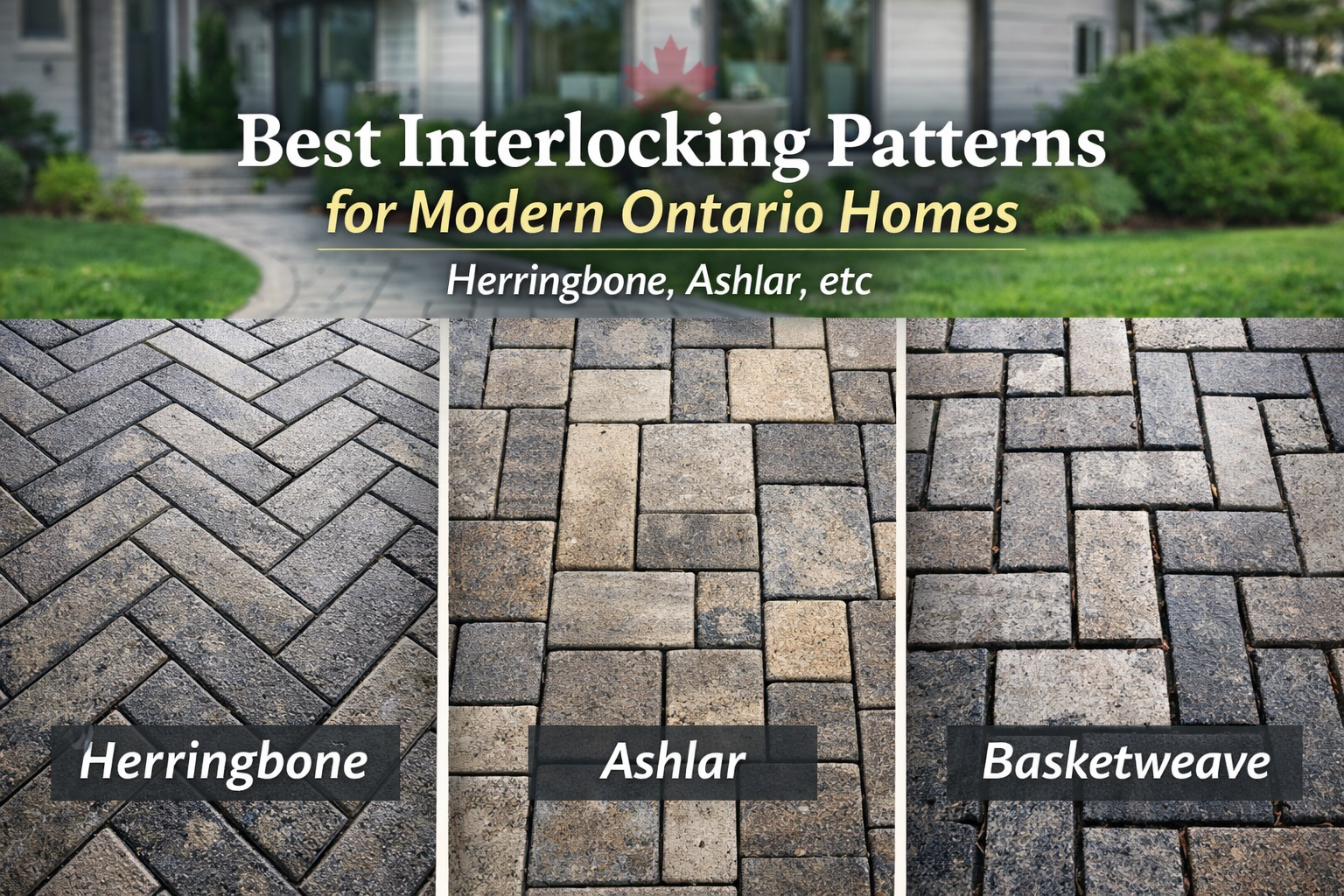
The herringbone interlocking pattern is the most reliable option for Ontario driveways. Rectangular pavers are laid at alternating angles, forming a tightly locked structure that resists movement from all directions.
Why herringbone dominates Ontario driveways
- Handles heavy vehicles common in Toronto, Brampton, and Mississauga
- Resists shifting caused by freeze–thaw cycles
- Performs well under snowplows used across GTA cities
- Minimizes rutting over long-term use
2026 design trend
Homeowners in Vaughan, Markham, and Richmond Hill are pairing the herringbone interlocking pattern with charcoal and graphite tones, finished with clean soldier-course borders for a modern look.
Among all modern interlocking driveway patterns in Ontario, herringbone remains the strongest and most widely recommended layout.
Random Ashlar (Modular) Pattern
Best for: Patios, pool decks, backyard living spaces
Structural performance: High for pedestrian use
The random ashlar pattern uses multiple stone sizes arranged to avoid continuous joint lines. It is especially popular in suburban cities like Oakville, Burlington, and Whitby, where outdoor living spaces are a priority.
Why it’s one of the most popular interlocking designs in Ontario
- Mimics natural stone installations
- Softens modern architectural lines
- Conceals minor settlement from frost movement
- Works well with landscaping and garden features
Ashlar is ideal where visual appeal and flexibility matter more than vehicle load resistance.
Running Bond (Linear Pattern)
Best for: Walkways, side yards, modern patios
Structural performance: Moderate
Running bond features staggered rows laid in parallel lines. Its clean, linear geometry aligns well with contemporary homes in Toronto, Mississauga, and downtown infill developments.
Key benefits
- Visually lengthens narrow walkways
- Requires less cutting, reducing installation costs
- Pairs well with large-format slabs
Large-Format Linear Patterns
Best for: Modern patios and outdoor entertainment zones
Structural performance: High with professional installation
Large-format pavers arranged in linear patterns are increasingly common in luxury homes across Vaughan, Oakville, and Richmond Hill. These layouts create a seamless, modern appearance with fewer visible joints.
Ontario-specific considerations
- Requires precision excavation and grading
- Performs best on well-drained sites
- Often paired with porcelain or premium concrete pavers
This pattern prioritizes aesthetics and should always be installed by experienced professionals.
Geometric and Hexagonal Patterns
Best for: Front entrances, accent areas, feature zones
Structural performance: Moderate
Geometric layouts—especially hexagonal pavers—are being used selectively across Ontario cities to create visual focal points.
Why they’re trending
- Add architectural interest to entrances
- Break up large paved surfaces
- Work well as accents within ashlar or linear designs
These patterns are most effective when used strategically rather than across entire surfaces.
Pattern Comparison for Ontario Homes
| Pattern | Ideal Application | Load Resistance | Design Style |
| Herringbone | Driveways | Very High | Classic / Modern |
| Ashlar | Patios | Medium–High | Natural / Refined |
| Running Bond | Walkways | Medium | Minimalist |
| Large-Format Linear | Patios | High | Contemporary |
| Geometric / Hex | Feature Zones | Medium | Architectural |
Borders, Colors, and Finishing Trends Across Ontario (2026)
Across Toronto, Mississauga, Vaughan, and surrounding cities, finishing details are playing a major role in performance and aesthetics:
- Popular colors: Charcoal, grey, greige, warm beige
- Borders: Soldier-course borders for edge stability
- Surface textures: Matte finishes for winter traction
Borders are not just decorative—they help control lateral movement during seasonal ground shifts.
Installation Quality Matters More Than City or Pattern
Regardless of location—Toronto, Brampton, Oakville, or Durham Region—interlocking longevity depends on:
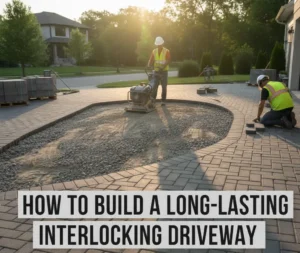
- Proper excavation depth
- Fully compacted granular base
- Correct grading for drainage
- Secure edge restraints
Most interlocking failures across Ontario result from inadequate base preparation, not pattern choice.
Conclusion
In 2026, homeowners across Ontario are choosing interlocking layouts that combine engineering logic with architectural design. The herringbone interlocking pattern continues to lead for driveways, ashlar remains the preferred option for patios, and linear or geometric layouts add modern character to walkways and entrances.
When installed correctly and matched to local conditions, the best interlocking patterns for Ontario homes enhance durability, curb appeal, and long-term property value—whether in Toronto, Vaughan, Mississauga, or beyond.
Frequently Asked Questions (FAQs)
- Which interlocking pattern is best for Ontario driveways?
For most properties, the herringbone layout remains the top choice among modern interlocking driveway patterns Ontario homeowners prefer, as it distributes vehicle weight evenly.
It performs reliably under Ontario’s freeze–thaw cycles, heavy traffic, and snowplow use. - Why is herringbone considered the strongest interlocking pattern?
Its angled layout locks pavers together from multiple directions, reducing lateral movement.
This strength is why it’s one of the most trusted and popular interlocking designs in Ontario for driveways. - Is the ashlar pattern suitable for Ontario’s climate?
Yes, ashlar works well for patios and walkways when installed on a proper granular base.
Its modular layout helps conceal minor settlement caused by seasonal frost movement. - Can running bond be used for interlocking driveways?
Running bond is not recommended for driveways due to lower load resistance.
It is better suited for walkways and patios when choosing interlocking patterns for low-traffic areas. - What interlocking pattern works best for modern homes in Ontario?
Linear, large-format, and ashlar layouts are among the most popular interlocking designs in Ontario for modern homes.
They offer clean lines, fewer joints, and a refined contemporary appearance. - How do I choose the right interlocking pattern for my property?
Knowing how to choose interlocking patterns starts with understanding usage, drainage, and load requirements.
Driveways need structural patterns, while patios allow more design flexibility. - Do interlocking patterns affect drainage performance?
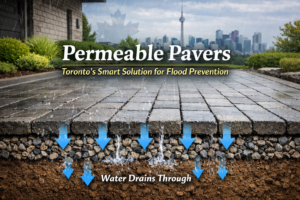
The pattern itself does not control drainage, but joint spacing and base construction do.
Many modern interlocking driveway patterns Ontario contractors use can support permeable systems when required. - Are large-format pavers durable in Ontario winters?
Yes, when installed on a stable, well-compacted base with correct grading.
Porcelain and premium concrete slabs perform especially well through freeze–thaw cycles. - Can different interlocking patterns be mixed on one property?
Yes, mixing layouts is a growing trend across Ontario.
For example, herringbone driveways combined with ashlar patios help define spaces while keeping a cohesive design. - Do complex interlocking patterns increase installation costs?
Yes, layouts like herringbone or European fan require more cutting and labor.
This can increase costs by roughly 10–15%, but these remain popular interlocking designs in Ontario due to long-term durability.